

If you only focus on traditional advertising, it can be cost prohibitive unless you have a multi-million dollar Marketing budget. But there are plenty of cost-effective marketing strategies available, like content marketing, social media marketing, street presence and low-cost events.
Establish a Baseline
Let’s say we are just starting our business and the two-year milestone we are targeting is a $500k/yr runrate. According to the US Small Business Administration, The CMO Survey 2025 and other sources, the average spend is 5–10% of revenue or $25-$50k/yr. As a new startup we may, or may not have have that in our budget but it’s always the case that the marketing budget is a limited precious resource that must be put to work and not squandered. How should we plan our Marketing strategy?
Typical Marketing Services Purchased – Based on Industry Assumptions
The table below can be used to give us a general idea as to the types of services we might buy and what they might cost. Before we start planning our actual budget, we need to take several other factors into consideration in order to customize the marketing plan to our actual budget, business goals and most importantly, our target clientele.

*Note: Table generated by claude.ai using the cited data
Paid Acquisition – Google PPC & Social Media Ads
CAUTION: Before pouring money into paid acquisitions, Note: According to Crestmont Capital, The average cost-per-click for high-competition categories like financial, legal, IT Service or security keywords can range from $5–$15 or more. For professional services the conversion rate to Marketing Qualified Lead (MQL) is typically less than 2%. And the rate from MQL to sale is typically between 4-10%. Meaning, at $10/click it will cost you at least $50,000 per sale using paid acquisition.
Unfortunately, I have too often seen organizations squander large portions of their limited budget on paid acquisition without realizing a proper ROI. Before considering PPC and Paid Social media, let’s be sure we leverage all our less costly options first.
The key is to focus your efforts on the techniques that will be most effective for your business and target market. Marketing is a long-term game. Sustainable growth comes from consistent effort over time.
Align Your Marketing Projects With Your Business Mission
Defining Your Target Market and Focusing On It, is the Only Winning Strategy in Marketing.
Marketing is about communicating your core value proposition clearly, convincingly, and consistently. It is a critical function that links your organization’s vision and mission to your client base.
The best marketing for small businesses is whatever it takes to reach enough target customers to satisfy your business goals. What this looks like will vary depending on your business, your ideal clientele, your creativity and budget.
There are any number of marketing tools and channels you can choose to deploy but they all take money, time and effort. It’s important to carefully align your limited marketing resources to your business mission and goals.
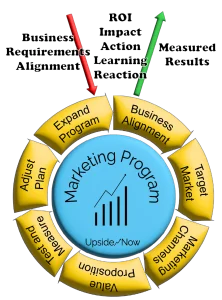
Seven Steps to Creating Your Marketing Plan
- Align with business goals using ROI model
- Carefully define your target market
- Determine the appropriate communication channels
- Define value proposition
- Test targeted campaigns
- Measure, analyze, adjust; Repeat as necessary
- Expand on what works, eliminate what doesn’t
Why Do I Need to Define My Target Market?
Defining your target market and focusing on it, is the only winning strategy in Marketing.
The first step to planning an effective Marketing plan is to carefully identify your target market. Carefully defining your target market and focusing on it is the only winning strategy in marketing. Who are your ideal customers? Where are they physically and online? What need do you fill? What are the alternatives? Who is the competition? What is the best marketing mix to reach them? Etc.
How Can You Measure the ROI of a Marketing Project?
Measure the success of Marketing projects along five levels of buyer journey.
According to The CMO Survey 2025, the most pressing challenge for marketing leaders today is demonstrating the impact of actions on financial outcomes. Managing marketing as a growth engine. is the weakest skill among senior marketing leaders today. There is increasing pressure to ‘prove the value of marketing’. This holds true for all size organizations from very large corporations to small businesses.
According the book ‘ROI in Marketing’, value is embedded in marketing, yet marketers struggle to demonstrate said value at the executive level. Turning marketing from art to science is tricky, nevertheless there are tools we can use to get to an estimate of ROI.
Techniques for Measuring the ROI of Marketing Projects
Consider the buyer journey and results at each of five stages, then, we can both align with business requirements and measure the success of any Marketing initiative.
Measure the success of Marketing projects along five levels of buyer journey;
- Customer Reaction
- What the Customers Learned
- The Actions Customers Took
- Financial Impact (purchases)
- ROI (profit/cost)
There are a couple outstanding challenges when it comes to measuring the value of Marketing programs. First because so many variables are involved in customer decisions, it is difficult to isolate the effects of the Marketing initiatives. Secondly, it is difficult to translate intangible assets into monetary values. Therefore, most marketers have focused only on impact data for ROI calculations.
Intangible assets are often the key to competitive advantage and organizational success. Intangibles cover strategically important factors behind many well-known organizations’ success.
For Marketers, measuring reaction, learning and action is important. Failure in one of these areas can be measured analyzed and fixed earlier in the life cycle. If your organization has an operational method for monetizing the value of intangible assets you can use that to measure the Marketing results. If not, a simple point-scale method could be used (e.g. 0 – 5 stars).
The point is, using an ROI methodology can help plan to align & measure their projects with respect to your business mission.
Gorilla Marketing
Never underestimate the value of creativity, imagination and out-of-the-box thinking. Guerrilla marketing is an advertisement strategy in which a company uses surprise and/or unconventional interactions in order to promote a product or service. It is a type of publicity. The term was popularized by Jay Conrad Levinson’s 1984 (updated 2007) book Guerrilla Marketing. Guerrilla marketing uses multiple techniques and practices to establish direct contact with potential customers.
The key is to focus your efforts on the techniques that will be most effective for your business and target market. Marketing is a long-term game. Sustainable growth comes from consistent effort over time.
Final Thought
Align Marketing strategy to the business goals.
If you are considering hiring a Marketing agency, ask them how they plan to align & measure their projects with respect to the business mission. Are they primarily interested in your success or do they just want to sell you their latest ‘thing’? Do they have a business alignment process?
Leave a Reply